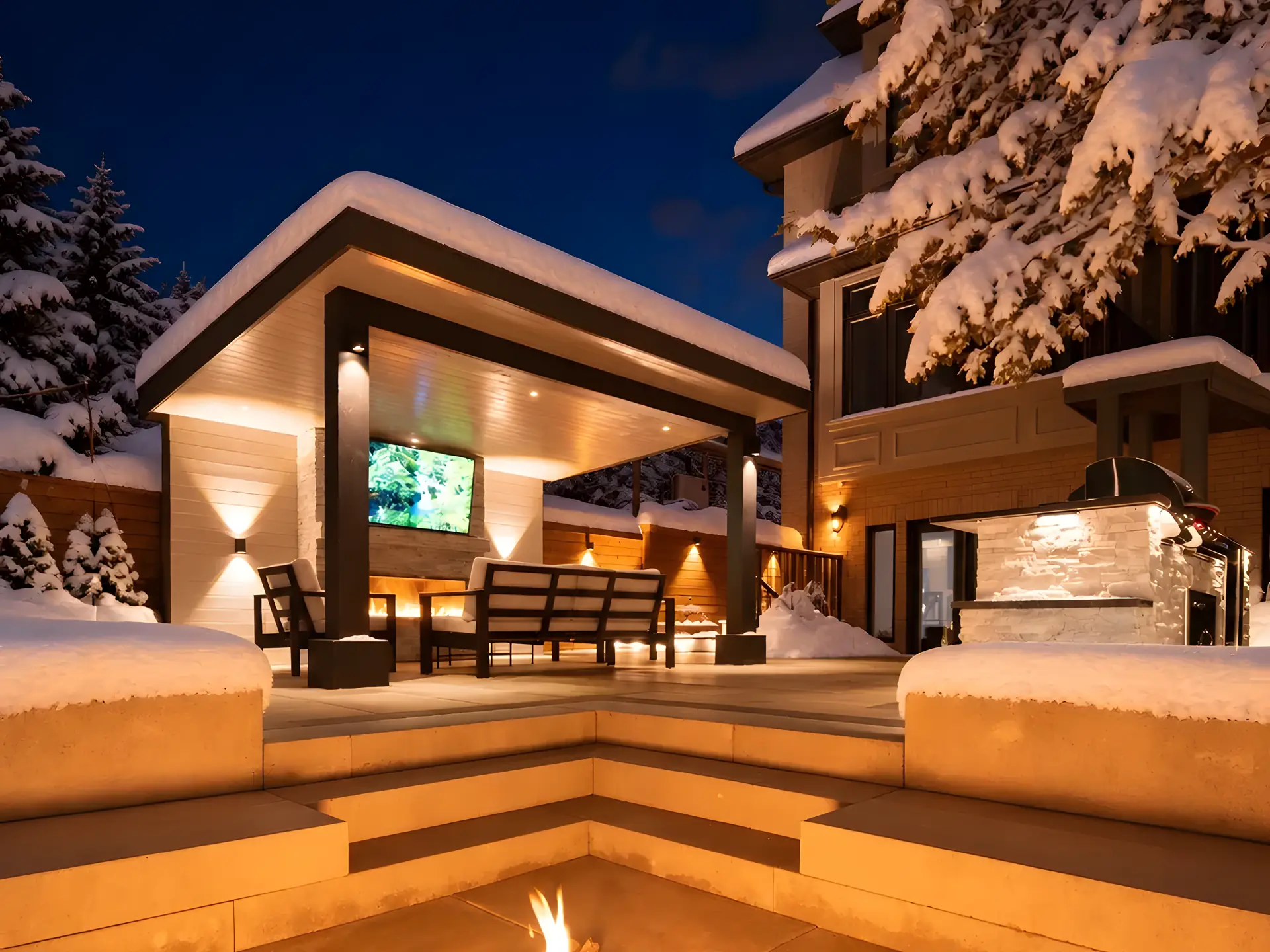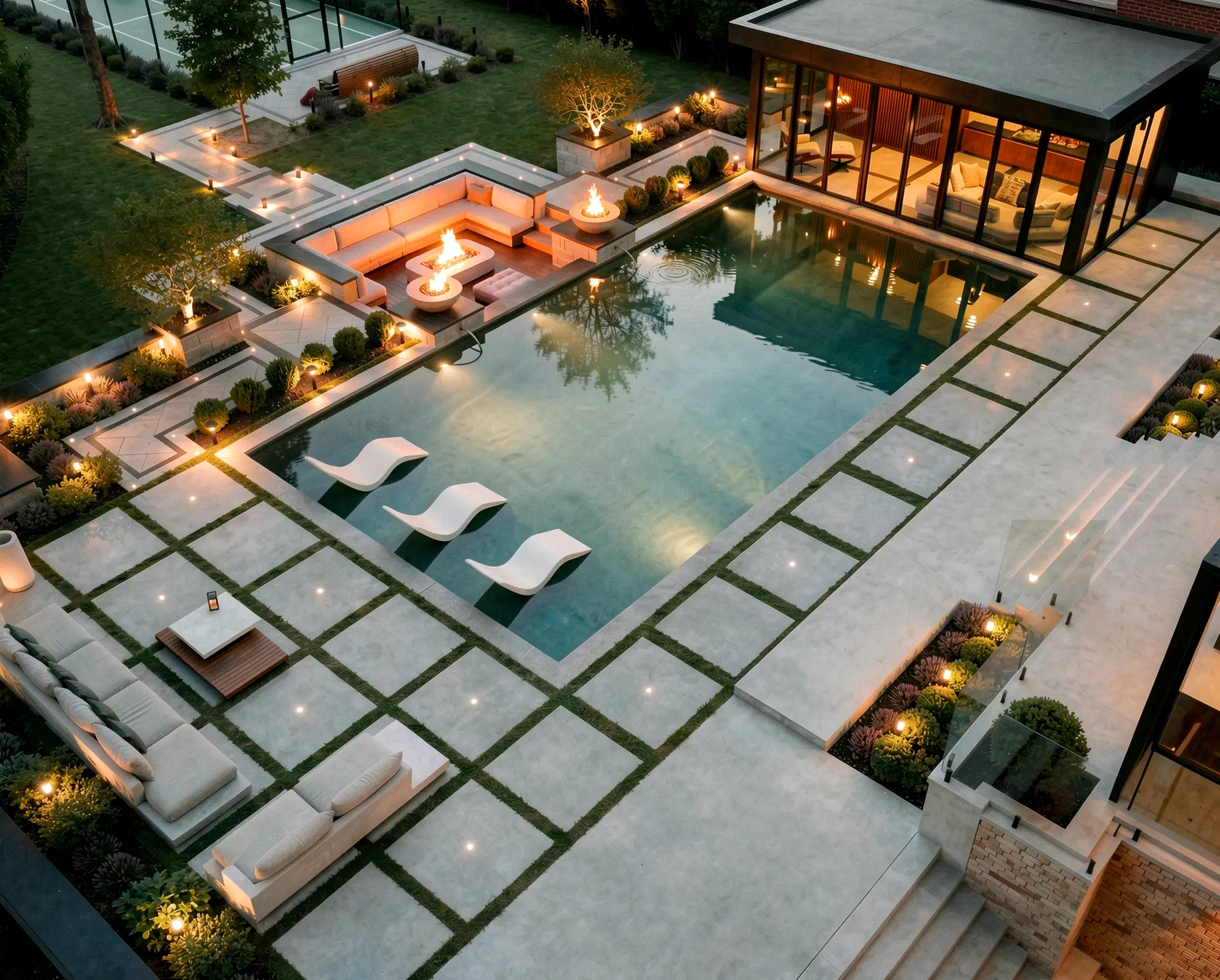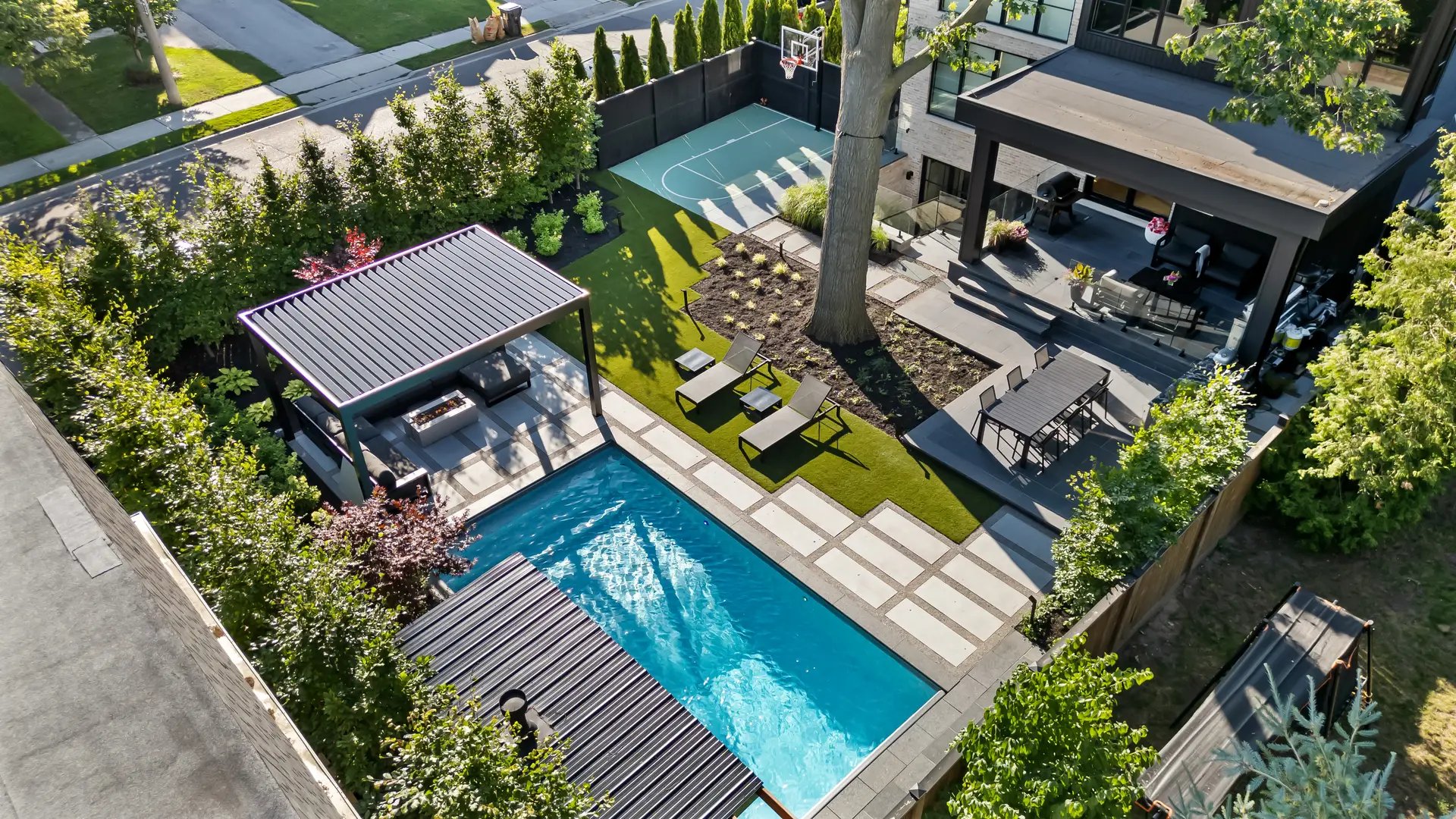

At Precision Landscaping, Pool Design options are not standalone upgrades. They are system decisions that affect Pool Installation cost, operating efficiency, and how the backyard performs across a short swim season.
In Ontario, pool design is not just about the shell. It is about the full system:
- The cover strategy
- The heating approach
- The automation platform
- The lighting
- The deck material
- How every feature connects to the surrounding outdoor environment
Municipal permits, enclosure bylaws, ESA electrical compliance, TSSA gas compliance, and conservation authority requirements all affect what can be built and how much it will cost.
This guide breaks down the pool design options that matter most for Ontario homeowners, including what each feature does, how it changes installation and ownership cost, and when it makes sense for your property.
Pool Types Available in Ontario
Every pool design decision starts with the pool type. The right pool type depends on lot size, maintenance expectations, installation access, and long-term ownership goals. Precision Landscaping designs and installs the following pool types across Ontario:
| Pool Type | Typical Installed Cost | Best For |
|---|---|---|
| Fiberglass Pools | $90,000 - $120,000+ | Predictable timelines, low-maintenance surfaces |
| Concrete Pools | $170,000 - $400,000+ | Fully custom shapes, depths, and architectural poolscapes |
| Steel-Vinyl Pools | $60,000 - $100,000 | Flexible sizing, family recreation, accessible investment tier |
| Plunge Pools | $45,000 - $95,000+ | Compact hydrotherapy, cooling, and architectural integration |
| Swim Spas | $20,000 - $60,000+ | Year-round swim-current and hydrotherapy |
| Modpools | $100,000 - $140,000 installed | Restricted-access sites and modern architectural projects |
| Hot Tubs | $8,000 - $20,000 | Standalone hydrotherapy for year-round use |
The design options covered in this guide apply across all pool types. Cover strategy, heating, automation, lighting, and deck integration should be planned together with the pool type from the start.
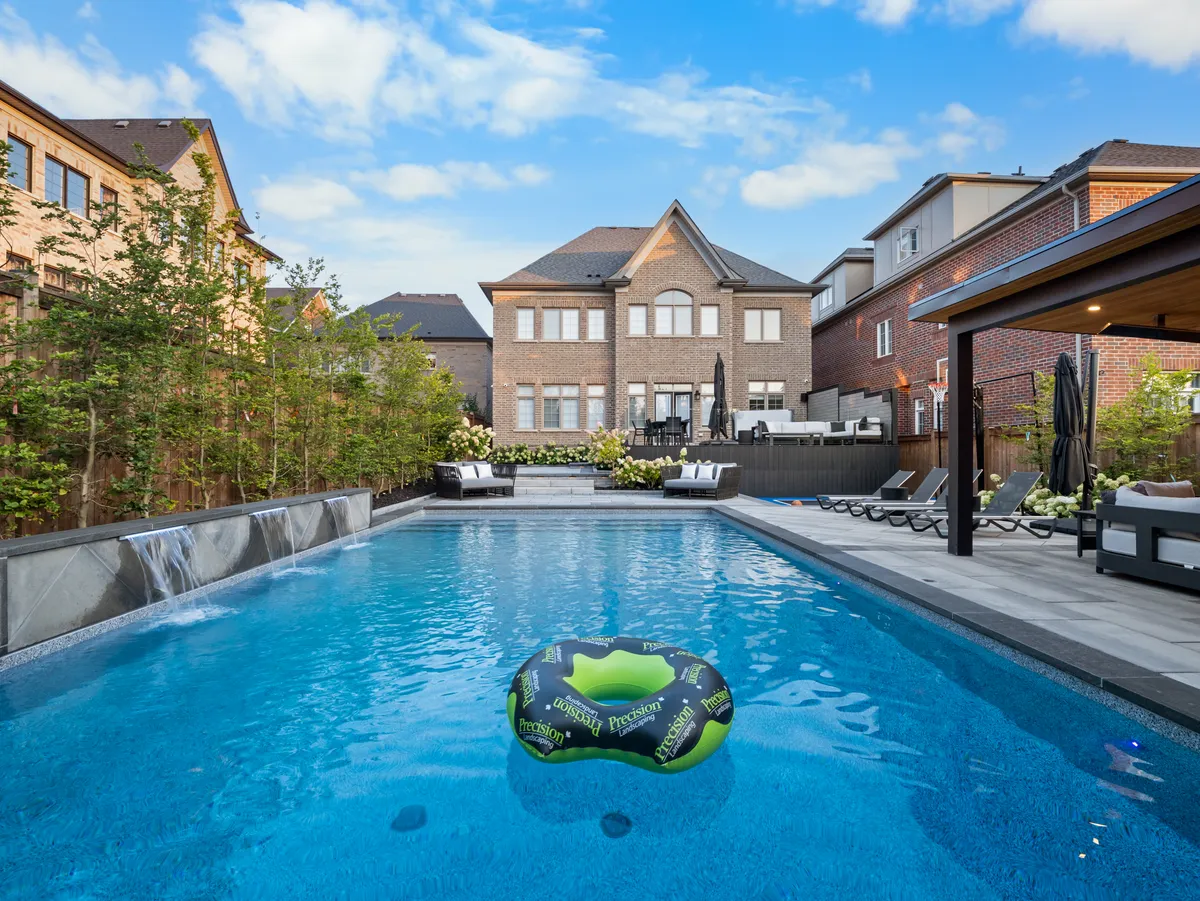
Pool Options at a Glance
| Option | Main Benefit |
|---|---|
| Automation and controls | Easier daily operation, smarter schedules, reduced wasted runtime. Fits homeowners who want low-friction ownership and better energy management. |
| Automatic or seasonal cover | Retains heat, reduces debris, improves shoulder-season usability. Essential for any heated pool that will be opened early. |
| Heating system | Extends the usable season beyond peak summer. Most valuable for family-use pools and shoulder-season swimmers. |
| Salt chlorination system | More automated sanitizer delivery and softer-feeling water. Fits owners prioritizing convenience over lowest upfront cost. |
| Water features | Adds movement, sound, and focal-point value. Most effective in design-led backyards with a visual composition. |
| Fire features | Extends evening use and shoulder-season comfort. Suits lounge-focused entertaining spaces. |
| LED lighting | Improves nighttime usability and safety. Essential for homeowners who will use the yard after dark. |
| Poolside integration | Better long-term performance across deck, drainage, utilities, and planting. Critical for every fully designed pool project. |
Why Ontario Changes the Order of Importance
In a warm climate, homeowners can treat a pool as a basin plus a few upgrades. Here, the short season changes the priority stack.
The outdoor season is significantly shorter than many southern jurisdictions. For most homeowners, maximizing shoulder-season use through covers, heating, and automation produces far more return than decorative upgrades.
Ontario's energy structure also affects ownership. The Time-of-Use and Ultra-Low Overnight pricing structures can make overnight filtration and off-peak heating significantly cheaper than daytime operation. This is not a general concept. It is a specific, measurable advantage when the equipment and automation are set up to exploit it:
- Filtration can be scheduled around cheaper electricity hours
- Circulation can run during off-peak or Ultra-Low Overnight windows
- Heat maintenance can be timed to avoid on-peak rates when the system supports it
- Natural gas rates fluctuate over time, affecting heater operating costs
Pool Covers That Make Sense in Ontario
Covers are not an afterthought. They are one of the most rational first upgrades because they affect heat retention, debris load, and spring opening condition. Energy efficiency authorities, including Natural Resources Canada, identify covering the pool as one of the most effective ways to reduce heating costs, with widely reported savings of 50% - 70%.
Cover Comparison
| Cover Type | Best Fit |
|---|---|
| Automatic Safety Cover | Daily-use safety, convenience, debris control, significant operating savings. About $15,000 - $30,000+ installed. Must be planned into coping and structure from day one. |
| Solar or Thermal Blanket | Lowest-cost in-season heat retention. Basic systems start around $2,500. Integrated concealment and roller systems run $3,800 - $8,000. More manual handling required. |
| Mesh Winter Safety Cover | Practical winter close strategy. About $2,500 - $3,800 installed. Lets water through but controls debris and provides winter security. |
| Solid Winter Cover | Cleaner spring opening with stronger debris and water control. Moderate to high cost. Needs water management and monitoring during the off-season. |
For a heated pool, the cover should usually be discussed before water or fire features:
- The cover retains the heat
- The heater recovers it
- Together, they reduce operating costs and extend the swim season more effectively than either feature alone
What to Plan at the Design Stage
The most important cover decision is when to plan for it. Automatic covers require design-stage coordination that is dramatically easier to build during initial construction than to retrofit later:
- Integrated tracks built into the pool shell
- Coping details matched to the track system
- Vault space for the cover mechanism
- Drainage routing around the vault and track housing
Pool Heating Systems
Pool heating typically involves a choice between gas heaters for rapid recovery and heat pumps for longer-term efficiency. The right choice depends on how the pool will be used, not on which heater costs less on a spec sheet.
| Heater Type | Best Use Case |
|---|---|
| Natural Gas Heater | Fast heat-up for weekend-heavy use, shoulder-season recovery, and entertaining. Requires gas service, line sizing, and a registered fuels contractor. Effective for quick heat, not usually the only efficiency strategy. |
| Electric Heat Pump | Steady temperature maintenance through the main season. Sensitive to electricity plan and runtime. Performs well when paired with a cover and consistent use patterns. Suits pools kept at temperature regularly. |
| Hybrid Strategy | Fast recovery plus efficient maintenance for high-use pools with extended season goals. Higher upfront complexity but wider performance flexibility. Suits high-use households. |
Standard pool heating systems typically cost about $4,000 - $8,000 installed, with hybrid systems exceeding that range. Heater choice is a platform decision, not a small accessory choice: gas rates fluctuate and electricity pricing varies by time of use, both affecting which heating strategy delivers the best long-term value.
Pool Automation Systems
Automation is most valuable when it coordinates real infrastructure:
- Pump schedules aligned to off-peak electricity
- Heating windows timed around rate tiers
- Lighting scenes for different evening uses
- Water-feature timing synchronized with filtration
- Seasonal transitions managed from an app
Its strongest use case is not novelty control. It is smarter runtime management during a short swim season and more efficient shoulder-season operation. Covers, heaters, and pumps all benefit from time-based scheduling that responds to rate structures. The leading pool automation platforms all provide app-based control of:
- Pumps and filtration scheduling
- Heaters and temperature setpoints
- Lights and colour scenes
- Salt systems and sanitizer output
- Water features and valve actuators
The practical differentiator is compatibility with the planned feature bundle and dealer support. Automation platforms typically range from $2,500 - $7,000+ installed, depending on features and scope.
| Platform | Best Fit |
|---|---|
| Full ecosystem platforms | Design-forward builds with multiple loads and future expansion. Deep integration when the equipment stays within one manufacturer. |
| Mid-range automation platforms | Mid-range to higher-end pools. Good salt and automation overlap with voice assistant compatibility. Solid feature depth at accessible pricing. |
| Remote-first platforms | Projects that prioritize remote control and home-automation compatibility. Broad connected control with good fit for existing smart-home ecosystems. |
The economic case is strongest when automation shifts filtration, heating, and circulation into off-peak and Ultra-Low Overnight windows. The cost case is weaker when automation only controls decorative elements.
Water Features
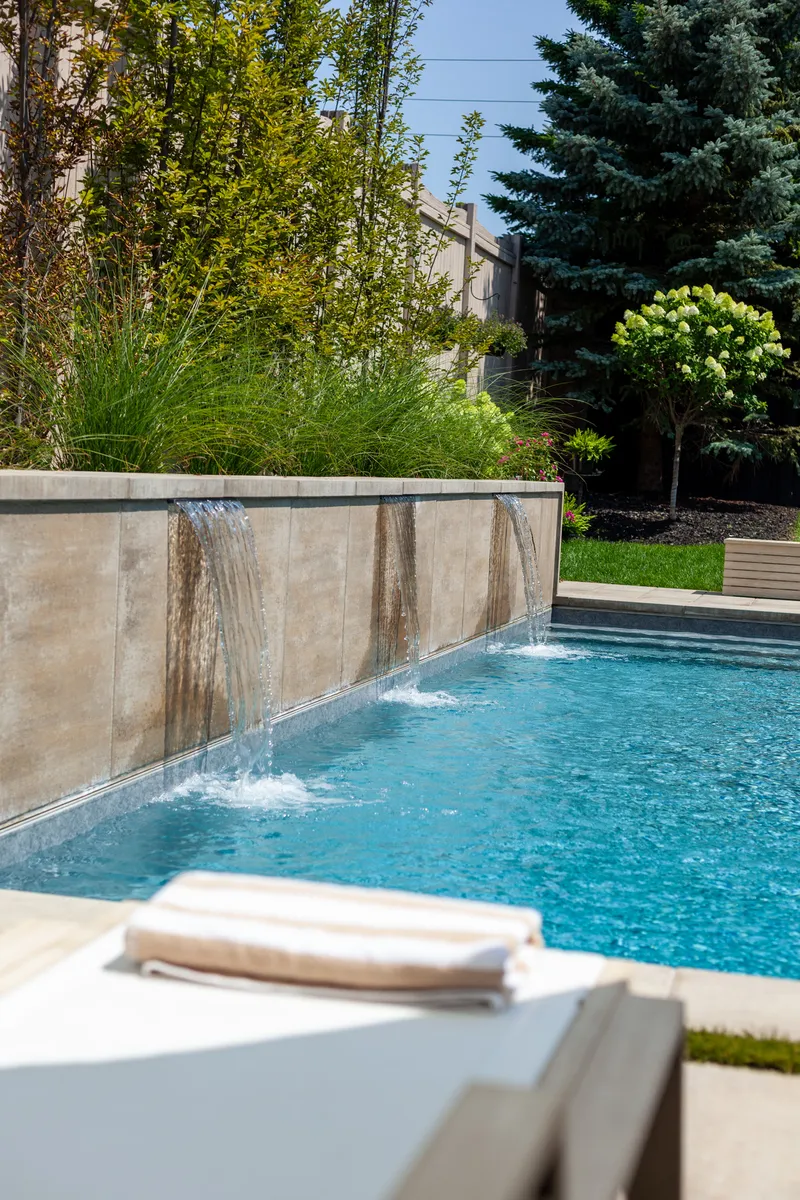
Water Features in a pool environment serve both aesthetic and functional purposes. They add sound, visual movement, and in some cases improve water circulation. They also add plumbing, valves, controls, and maintenance requirements that should be planned during design, not added at the end.
Common water feature types and where they perform well:
- Bubblers are effective on tanning ledges where they add movement and circulation
- Deck jets and laminars create arcing streams that perform well at night with LED lighting
- Spillover spas combine hydrotherapy with a built-in waterfall effect
- Sheer descents create a clean, architectural water curtain
For pools with salt chlorination, evaporative water features require extra consideration:
- Spillovers and waterfalls can leave salt deposits on surrounding surfaces
- Salt systems are not a zero-thought choice when the design depends heavily on sheer descents or spillways
Water feature packages typically range from about $5,000 for selective features to $10,000 - $20,000+ for comprehensive integration with multiple elements.
Fire Features
Fire Features extend the comfort and usability of the pool area into Ontario's shoulder seasons:
- Fire bowls on pool walls create dramatic accent lighting and radiant warmth
- Linear burners along seating walls define entertaining zones
- Freestanding fire pits create a natural gathering point
The design rule for fire features near pools: treat them like real fuel-fired appliances, not decor:
- The TSSA advises that fixed fuel-fired fire pits and fireplaces must be installed by a TSSA-certified technician
- Installation must be in open outdoor areas away from combustible materials
Precision Landscaping places fire features on a dedicated Hardscaping plane with planned seating sightlines, safe walking clearances, and splash separation from the pool edge.
| Fire Feature | Typical Cost |
|---|---|
| Basic fire pit | $500 - $2,000 |
| Custom fire pit | $5,000 - $10,000 |
| Outdoor fireplace | $10,000 - $30,000+ |
| Fire bowls (pair, pool-mounted) | $3,000 - $8,000 |
Pool and Spa Lighting
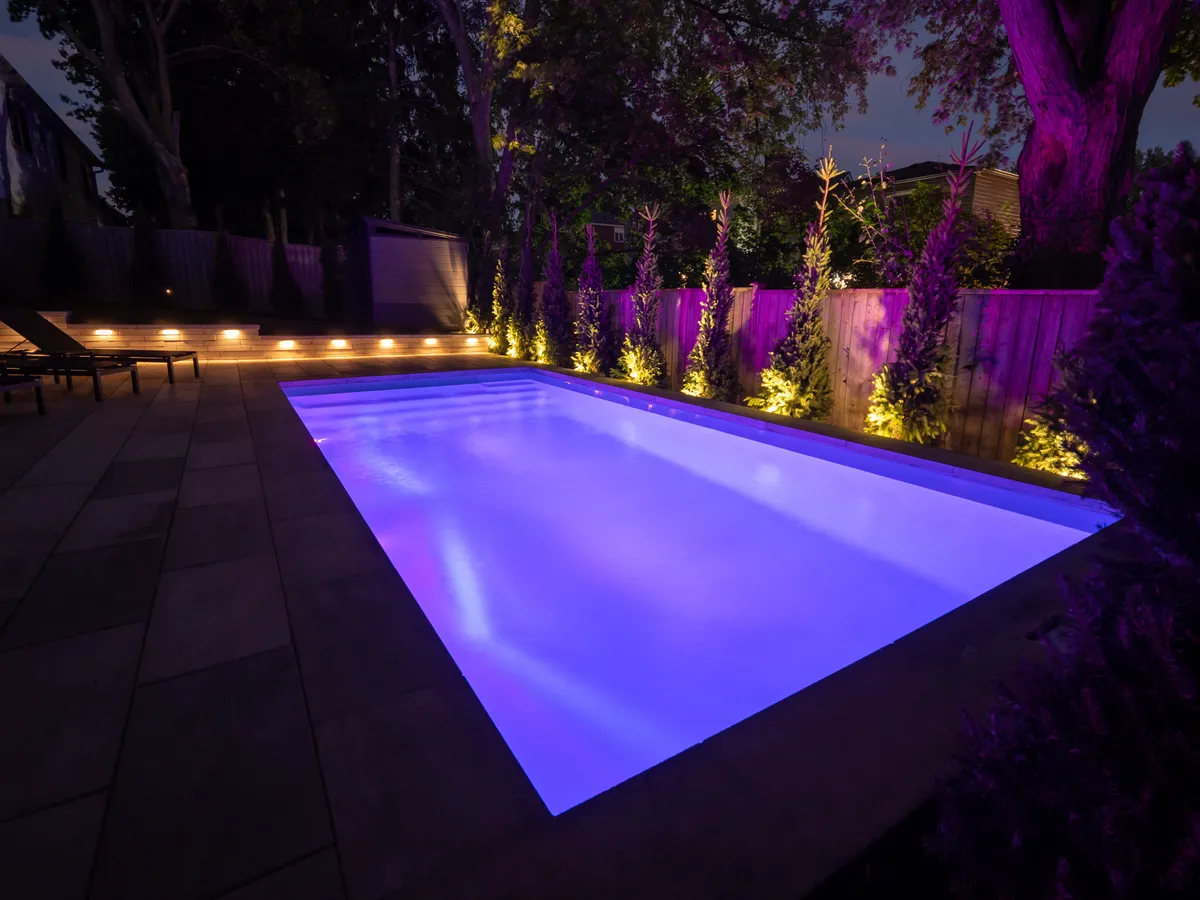
Lighting is now part of the control story, not just the finish story. Modern pool lighting integrates with automation platforms for app-based colour scenes, multi-zone control, and dimming.
The most useful lighting package is a layered approach:
- Underwater LED for the pool body
- Low-voltage path or step lighting for safe deck movement
- Architectural accent lighting on walls, planting, cabanas, or water features
- Separate control scenes for pool, step, and social lighting give flexibility for different evening uses
Pool LED lighting typically costs about $2,000 - $6,000 installed. The investment creates the single largest visual transformation between daytime and evening use, and it directly supports the safety of nighttime pool access.
Darker interior pool finishes perform well for both aesthetic and functional reasons:
- Deep blues, charcoals, and graphite tones enhance LED colour contrast at night, creating stronger visual impact after dark
- Darker finishes absorb more solar heat during the day, contributing to modest passive heat gain during the swimming season
Salt Chlorination vs Manual Chlorine
A saltwater pool is not chlorine-free. The practical difference is how the chlorine gets into the water, not whether it is present:
- Salt chlorination systems generate chlorine through electrolysis
- The pool still contains chlorine at all times
- Regular chemistry management is still required
Salt systems typically increase upfront cost but reduce manual sanitizer handling and fit well into an automated ownership model. Salt Water Pools have become the more common choice in new Ontario pool construction. The trade-offs include:
- Salt levels require regular monitoring
- The salt cell needs periodic maintenance and eventual replacement
- Material selection around ladders, rails, and nearby finishes must account for salt exposure
Choosing between salt and manual chlorine depends on ownership style:
- Salt chlorination makes the most sense for homeowners already investing in automation who prefer softer-feeling water with fewer hands-on adjustments
- Manual chlorine dosing often makes more sense for lower upfront equipment cost or less consistent use
- Either way, pH should be maintained in the 7.2 to 7.8 range
Integrated Spas vs Separate Hot Tubs
An integrated spillover spa creates a unified architectural composition:
- Water cascades from the spa into the pool, creating visual and acoustic effect
- The spa shares the pool's equipment, heating, and automation
- Plumbing, equipment sizing, and heating capacity should be designed around spa integration from the beginning
- Operation is simplified, but temperatures are connected between the two bodies of water
A separate hot tub unit makes more sense when the priority is:
- Independent year-round use, including full-temperature operation in January
- Easier isolated service without affecting the pool system
- A more appliance-like ownership model with no shared plumbing or heating
An integrated spa makes sense when the goal is one unified outdoor environment. A standalone hot tub makes sense for homeowners who want flexibility, lower entry cost, or the option to reposition the unit later. Integrated spa packages typically start at about $45,000 - $50,000+ when combined with the pool system.
Pool Deck Surfaces for Ontario
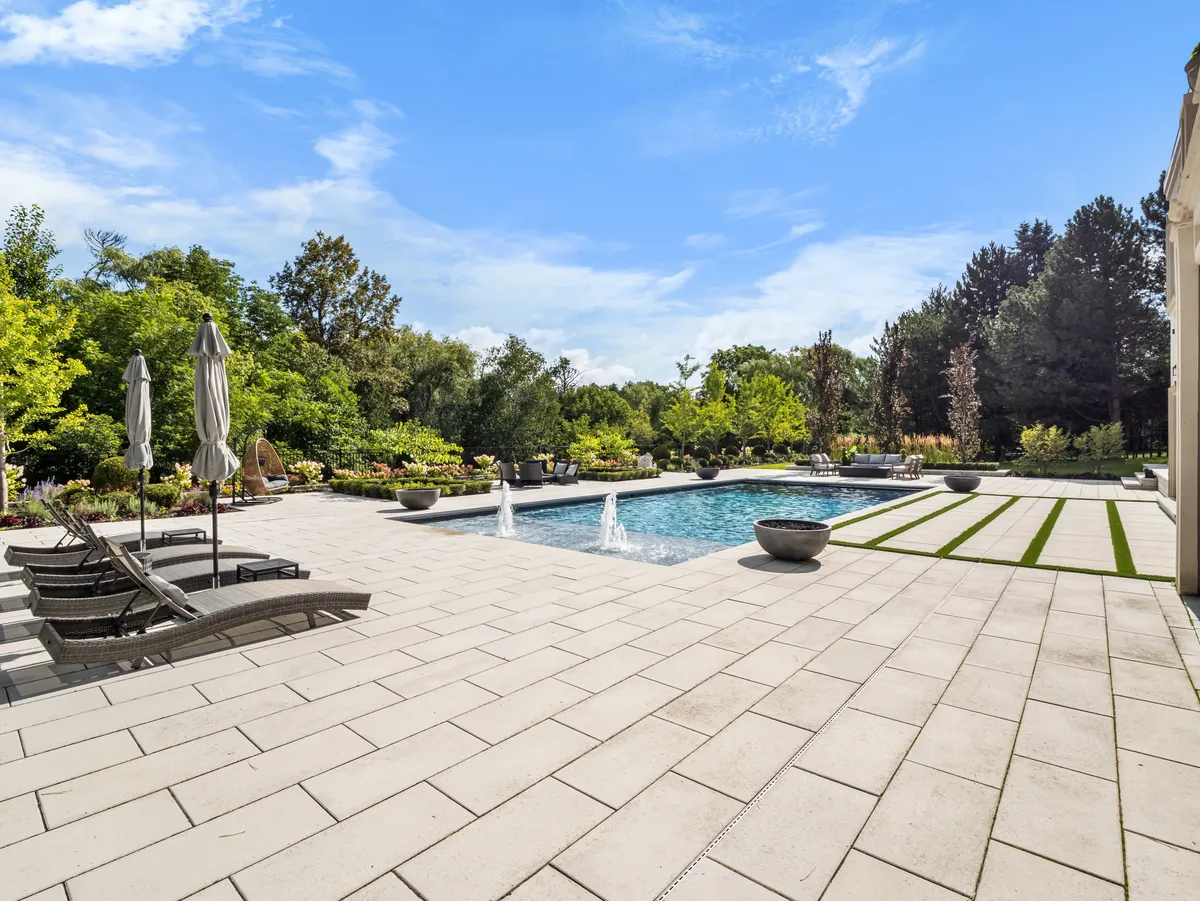
Pool deck material should be evaluated through four filters:
- Slip resistance under wet conditions
- Freeze-thaw performance across winters
- Maintenance burden over the life of the surface
- How well the material integrates with coping, drainage, and adjacent backyard features
Interlocking and Porcelain Pavers
Interlocking concrete pavers remain popular for pool decks for several reasons:
- Slip-conscious surface profile for wet-foot traffic
- Serviceable - individual pavers can be lifted and replaced
- Easy to integrate with broader hardscaping design
- Porcelain pavers withstand freeze-thaw cycles and clean easily
- Interlocking installation typically runs about $10 - $30 per square foot
- Interlocking Slabs run about $25 - $45 per square foot
Composite and PVC Decking
Deck Installation with composite or PVC materials can perform well in pool environments. PVC is positioned as highly water-resistant and low-maintenance:
- Fits pool-adjacent raised lounging zones where drainage and ventilation can be managed
- Works well as cabana aprons or transitional dining areas
- Fits projects that call for a warmer, more architectural deck language
Natural Stone and Architectural Concrete
Natural Stone and architectural concrete each serve different design goals:
- Natural stone creates an organic deck language that pairs well with luxury pool compositions
- Exposed-aggregate finishes are slip-resistant and well-suited to heavily trafficked family pool decks
- Textured concrete finishes offer durability and consistent performance across winters
High-Impact Features and Ontario Cost Ranges
| Feature | Typical Cost Range |
|---|---|
| Automatic cover | $15,000 - $30,000+ |
| Pool heating system | $4,000 - $8,000 |
| Smart automation | $2,500 - $7,000+ |
| LED pool lighting | $2,000 - $6,000 |
| Water features | $5,000 - $20,000+ |
| Integrated spa | $45,000 - $50,000+ |
| Fire features | $500 - $30,000+ |
| Interlocking pool deck | $10 - $45 per sq. ft. |
| Outdoor kitchen | $10,000 - $50,000+ |
| Cabana | $25,000 - $150,000+ |
These are planning ranges, not quote ranges. Final pricing depends on pool size, site conditions, feature combination, and integration complexity. For a full pricing breakdown by pool type, see Pool Cost. For cover-specific pricing, see Pool Covers Cost.
Which Features Fit Which Backyard
The right feature package depends on how the backyard will actually be used.
| Backyard Goal | Best Use Case |
|---|---|
| Family-first backyard | Fiberglass pool, automatic cover, variable-speed pump, salt system, LED lighting, durable interlocking deck, modest fire features. Strong safety and operating efficiency for daily summer use. |
| Entertaining backyard | Pool plus automation, layered lighting, water features, Outdoor Kitchens, fire bowls or linear burner, generous hardscaping, optional autocover. Best for owners who use the backyard at night. |
| Compact urban yard | Plunge pool (typically 10 to 14 feet) or compact fiberglass, solar blanket, selective automation, porcelain or interlocking deck, small-scale fire features. Strong fit for hydrotherapy and entertaining on tighter Toronto and GTA lots. |
| Luxury estate | Custom composition with integrated spa, automatic cover, full automation, layered LED lighting, water and fire features, cabana, Pergolas, and outdoor kitchens. Ontario's short season makes integrated heat planning essential. |
Build the Pool as One Backyard System
Pool options deliver the most value when they are coordinated across the full backyard system:
- Drainage planned around the pool, deck, and equipment pad
- Deck elevations set relative to coping, thresholds, and grading
- Equipment access routes cleared for service and seasonal maintenance
- Lighting circuits run during framing, not after finishing
- Planting setbacks maintained for root protection and sightlines around Gardens zones
- Seating zones positioned with fire, water, and lighting integration in mind
- Courts and other backyard features coordinated for shared grading and drainage
That is the most important takeaway in this guide. When automation, covers, lighting, water features, decking, and surrounding structures are planned together, the project performs better visually and technically. Mechanical space, coping details, conduit runs, and drainage routes can be planned once instead of retrofitted later.
Pool Installation, Pool Design, Pool Landscaping, and Landscape Design all work together when coordinated from the start. The pool shell is what you see. The systems around it are what make the backyard work.
Ontario Planning and Compliance
Ontario pool projects are governed through multiple layers of compliance. These are not afterthoughts. They are design-stage decisions:
- Municipal building permits for in-ground pool installation
- Enclosure bylaws with specific gate and fencing requirements
- Trade-specific compliance for electrical and gas work
Permits and Enclosures
Most Ontario municipalities require a building permit for in-ground pool installation. Key enclosure requirements include:
- Self-closing, self-latching gates with locking hardware
- Minimum fence height requirements set by the local municipality
- In conservation-regulated areas, additional approvals under the Conservation Authorities Act may be required
Electrical and Gas Compliance
Electrical and gas work each have their own compliance authority:
- The ESA requires that electrical equipment within 3 metres of the inside wall of the pool generally have GFCI protection unless suitably separated
- The TSSA requires that gas appliance work, including pool heaters and fire features, be performed by a TSSA-certified technician employed by a TSSA-registered contractor
Drainage and Grading
Pool drainage must be planned before excavation:
- Pool discharge requirements vary by municipality. Saltwater is often restricted from storm sewers, while dechlorinated pool water may be permitted in some jurisdictions
- Site grading must direct water away from the pool structure, the house, and neighbouring properties
- On sloped lots or properties with tight access, Retaining Walls, drainage systems, and equipment access all need to be resolved during the design phase
Frequently Asked Questions About Pool Design Options in Ontario
These are the most common questions homeowners ask when planning pool features and upgrades in Ontario.
-
The options that consistently deliver the most daily-use value are automatic covers, heating systems, and LED lighting. Automatic covers improve safety, reduce operating cost, and simplify daily use. Heating extends the season. Lighting transforms evening use. Automation ties everything together into a system the homeowner actually uses.
-
For most pool owners, yes. Automatic covers reduce heating loss by 50% to 70%, control debris, improve safety, and simplify daily pool management. The investment works best when specified from day one so coping, vaults, tracks, and drainage are integrated cleanly into the pool design.
-
Gas heaters are best for fast recovery and weekend-heavy or shoulder-season use. Heat pumps are best for steady temperature maintenance over the main season, especially when paired with a cover. Some premium Ontario projects use both in a hybrid strategy. The right choice depends on how frequently the pool will be used and how the homeowner's electricity and gas rates compare.
-
Yes. A salt chlorination system generates chlorine through electrolysis rather than requiring manual dosing. The pool still contains chlorine and still requires regular water chemistry management, including pH maintenance in the 7.2 to 7.8 range. Salt systems reduce chemical handling but do not eliminate it.
-
The most useful automation features are pump scheduling, heater management, and lighting scene control. In Ontario, automation has real economic value when filtration and heating can be scheduled around off-peak electricity rates. The value case is weaker when automation only controls decorative features.
-
Water features add plumbing, valves, and controls, which increase both installation and maintenance complexity. Evaporative features like spillovers and waterfalls can also increase heat loss and chemical demand. Dedicated controls that allow features to run independently of main filtration help manage operating cost.
-
Most complete pool and backyard projects take several weeks to several months depending on design complexity, permitting requirements, site conditions, and feature integration. Fiberglass shells can be installed quickly, but the surrounding hardscape, features, landscaping, and commissioning extend the overall timeline.
Design a Pool That Performs as a Complete System
A successful pool project does not start with a feature list. It starts with a site plan. Precision Landscaping designs and builds complete pool environments, coordinating automation, covers, heating, lighting, and every surrounding feature into one project. Contact Precision Landscaping for a design consultation.