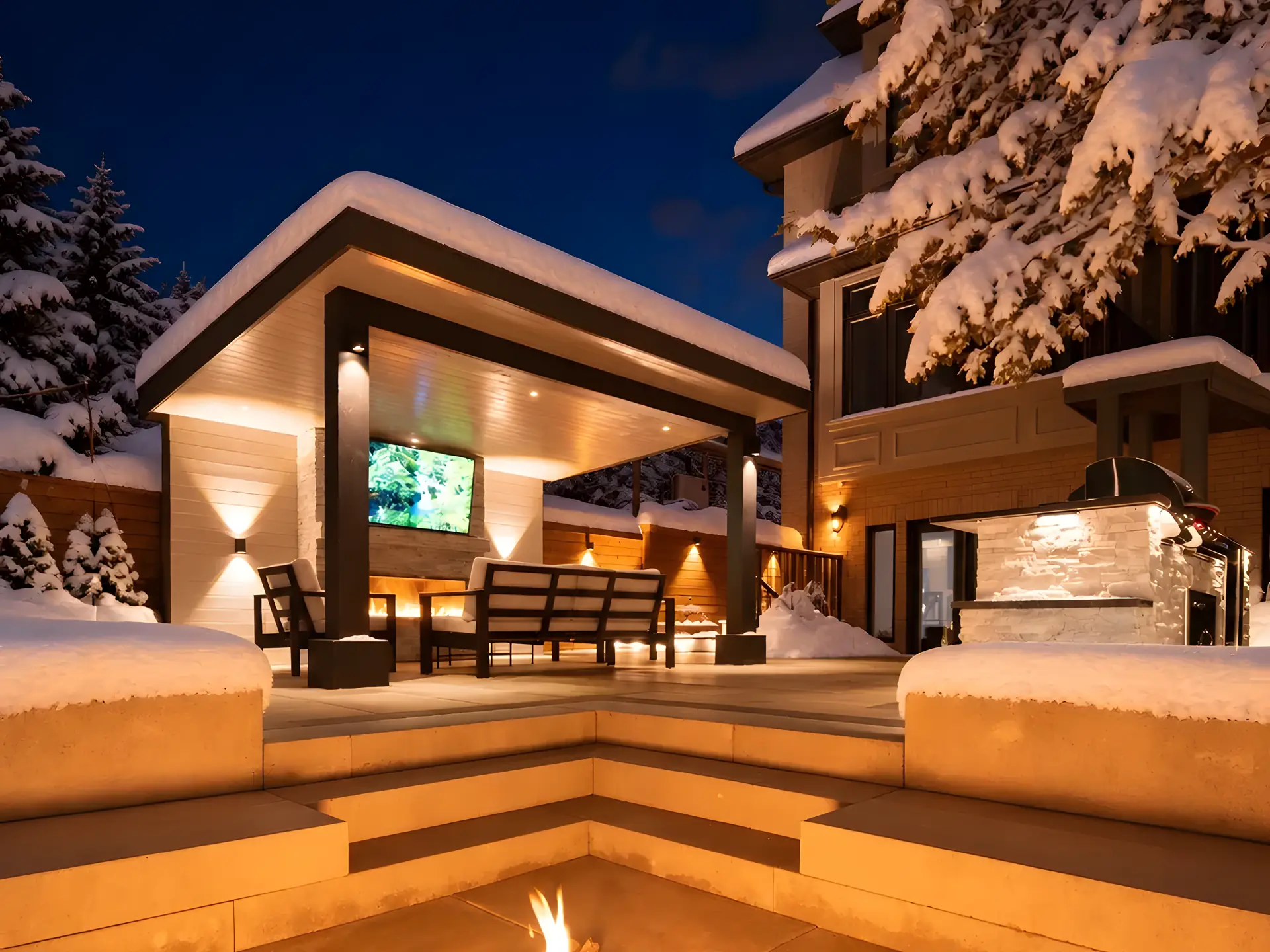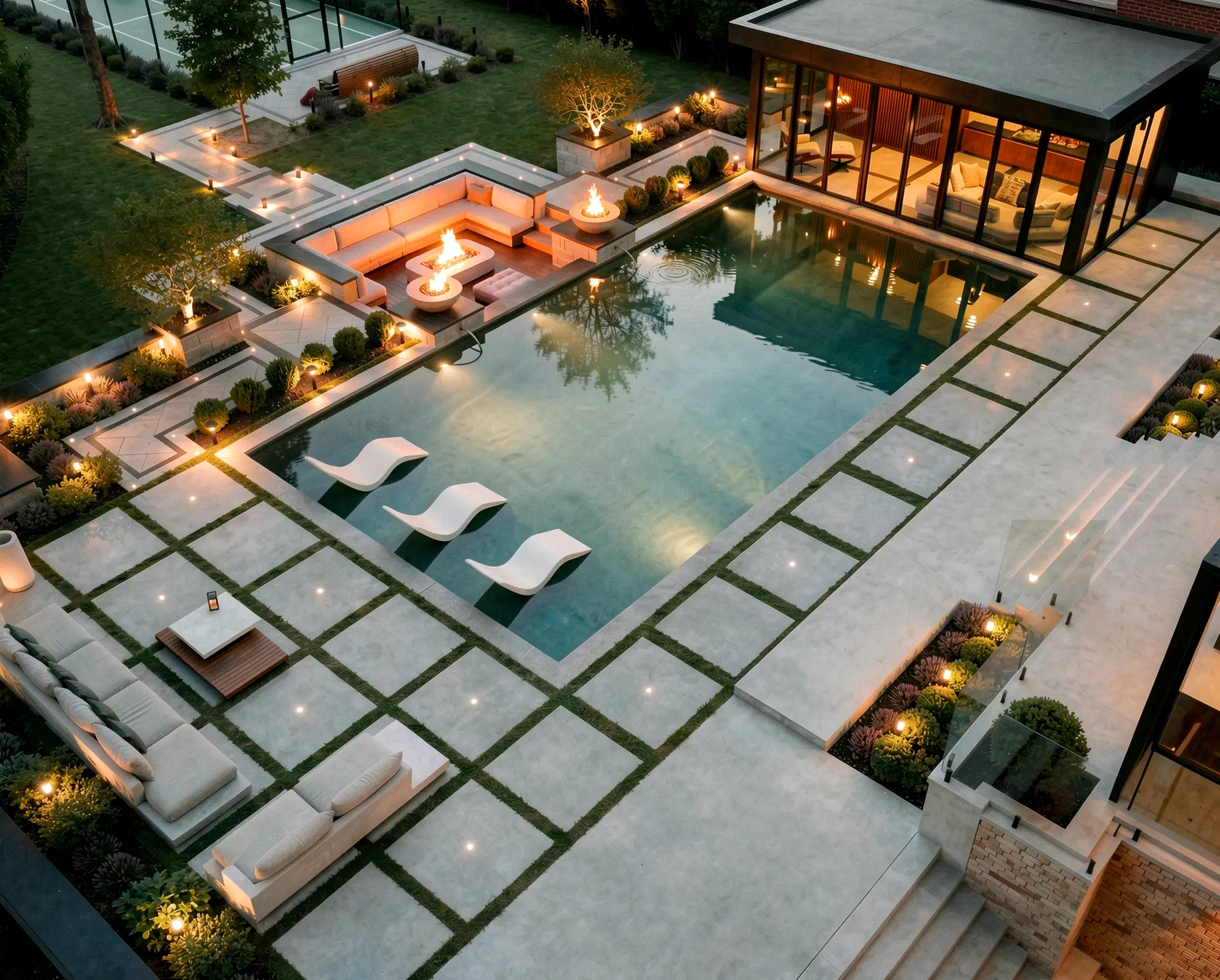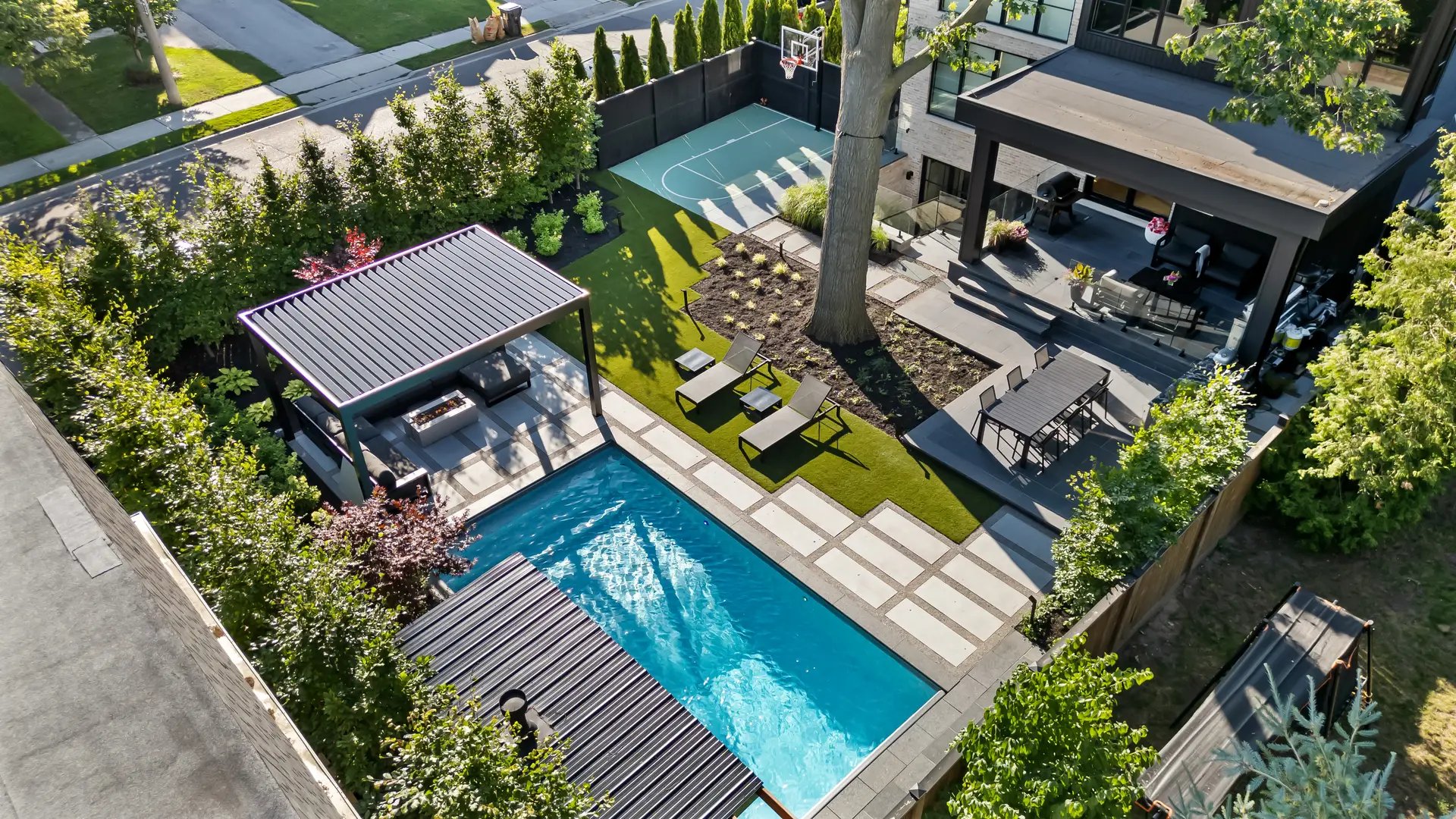

At Precision Landscaping, every Deck Installation is approached as a coordinated system, not a material selection exercise. The boards are visible but the structure, drainage, gapping, and fastening underneath are what determine whether those boards still look and feel right ten years later.
In Ontario, the decision between PVC and composite decking is shaped by moisture exposure, freeze-thaw cycling, sun exposure, and how the deck connects to the rest of the outdoor environment.
This guide breaks down the real differences between PVC and composite decking so Ontario homeowners can plan with confidence:
- Installed cost and budget planning
- Climate performance through the full seasonal range
- Maintenance requirements and long-term ownership costs
- Warranty coverage and material durability
- Which material fits which type of backyard project
PVC vs Composite Decking Cost in Ontario
Board price is only one component. The number that matters is installed cost per square foot, which includes the structure below the boards, not just the finish surface above it.
| Material | Installed Planning Range (Ontario 2026) | Best Fit |
|---|---|---|
| Pressure-Treated Wood | $55 - $65+ per sq. ft. | Lower first-cost projects |
| Composite | $75 - $100+ per sq. ft. | Good all-around installed value for most decks |
| PVC | $85 - $110+ per sq. ft. | Higher-end low-maintenance and wet-zone performance |
These are planning ranges, not quote ranges. Final pricing depends on:
- Deck height and framing complexity
- Stair count and configuration
- Railing material and style
- Site access and equipment staging
- Demolition of existing structures
- Whether an existing frame can be reused
For a standard 12x16 deck (192 square feet), the installed budget range breaks down like this:
| Material | Installed Range (12x16 Deck) |
|---|---|
| Composite | $14,400 - $19,200+ |
| PVC | $16,320 - $21,120+ |
The gap between composite and PVC is real, but it is not always the biggest variable. Structural framing, stair design, railing material, and site conditions often move the total budget more than board selection alone.
The Real Cost of Choosing the Wrong Decking Material
The wrong decking material does not just cost more later. It can lock a homeowner into the wrong build now. Common mistakes on Ontario deck projects:
- PVC boards often benefit from tighter joist spacing and more disciplined gapping than composite
- PVC is more sensitive to thermal movement than composite
- Framing built for wood or economy composite may not support PVC properly
- A mismatched resurfacing can result in bounce, visible deflection, or movement at joints
The second common mistake is choosing based on board price alone and ignoring the installation system:
- Hidden fasteners add labor and require compatible framing
- Picture-frame borders increase material waste and blocking
- Diagonal layouts require closer joist spacing
- Mitered returns demand precise fitting and gapping
- A lower board price with a more complex installation pattern can cost more than a higher board price with a straightforward layout
For Ontario homeowners, the third mistake is ignoring winter. Not all products tolerate the same ice melt chemicals, and using the wrong one can damage the surface or void the warranty.
Deck Installation Cost Breakdown by Phase
Deck boards get the most attention because they are visible. They are not the whole budget. The table below shows how the total installed cost breaks down across a typical Ontario deck project.
| Phase | Share of Total Budget |
|---|---|
| Design, site review, and permit coordination | 3% - 7% |
| Demolition and disposal | 5% - 12% |
| Footings and foundation work | 10% - 18% |
| Framing and structural carpentry | 20% - 30% |
| Decking boards, fasteners, and trim | 20% - 35% |
| Railings, stairs, skirting, lighting, and accessories | 15% - 30% |
What Actually Drives Deck Installation Cost in Ontario
Material selection matters, but it is only one of several cost drivers. In many projects, framing, stairs, railings, and site conditions account for a larger share of the budget than the decking boards themselves.
Deck Height and Structure
A raised deck changes the structural requirements significantly:
- Deeper footings extending below frost depth, typically 1.2 metres or more in Ontario
- More structural framing and often engineered connections to the house
- Footing depth set by municipal code, not by the board material
- Ground-level platforms on sleepers have a simpler structural profile but introduce different drainage and ventilation requirements
- Structural requirements must account for snow loads as well as frost depth and occupancy
Stairs and Access
Stairs add material, labor, and code-compliance complexity:
- Guard height requirements apply to stairs and landings
- Railing transitions at stair angles require precise detailing
- Ontario building codes require guards when the deck or landing height exceeds 600 mm relative to adjacent grade
- Stair stringers, treads, and risers add framing and finish material to the budget
Railings
Railing selection is one of the biggest single cost variables:
- Aluminum railings offer a strong balance of appearance, durability, and cost
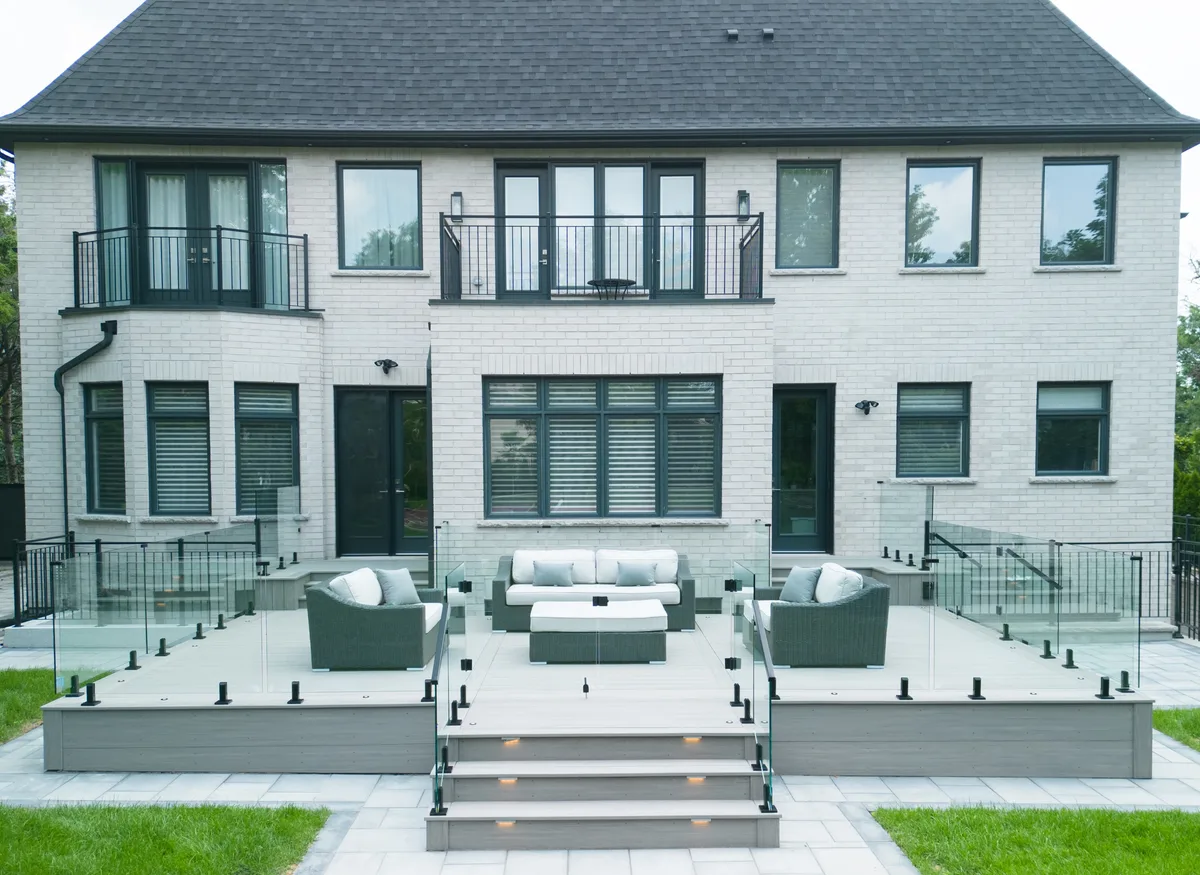
- Glass railings deliver an upscale look with a higher budget impact
- Cable systems provide a modern aesthetic but require engineering documentation
- Composite railings match the deck surface but vary in structural rating
- Each type may require different structural support or code-compliance paths depending on the municipality
Site Conditions
Site conditions affect cost in ways that are independent of board selection:
- Lot access affects equipment staging, material delivery, and demolition
- Sloped lots may require Retaining Walls, grading, or stepped framing
- Pool-adjacent decks need to coordinate with Pool Landscaping drainage and enclosure requirements
- Decks that integrate with Outdoor Kitchens, Pergolas, Cabanas, or privacy screening need utility coordination for gas, electrical, and water connections
Board Direction and Detailing
Board direction and detailing choices have a direct impact on framing and labor:
- Diagonal layouts typically require 12-inch joist spacing instead of 16-inch, increasing framing material and labor
- Picture-frame borders add waste, blocking, and fastening complexity
- Mitered corners and inlay patterns require precise fitting and additional material
- PVC's higher thermal movement makes tight miters and constrained borders more sensitive to expansion and contraction
- These details are where PVC and composite behave most differently
PVC and Composite Decking Features That Affect Cost
Beyond the base deck, the features homeowners choose during the design phase have a significant impact on both budget and long-term satisfaction.
| Feature | Why It Matters |
|---|---|
| Aluminum Railings | Major visual and budget driver for most decks |
| Glass Railings | Higher-end appearance with higher budget impact |
| Integrated Lighting | Extends evening use, best planned with layout |
| Skirting | Finished appearance, conceals storage and structure |
| Privacy Screens | Important for smaller suburban lots |
| Pergola Integration | Connects deck to a larger outdoor living system |
| Under-Deck Drainage | Essential for elevated decks with usable space below |
| Picture-Frame Borders | Higher-end finish detail that affects labor and material waste |
PVC vs Composite vs Wood Decking Comparison
The table below compares PVC, composite, and wood decking across the factors that matter most for Ontario homeowners.
| Factor | PVC | Composite | Wood |
|---|---|---|---|
| Core Construction | All-polymer, no wood fibers | Wood fiber and recycled plastic blend, most modern products are capped with a protective polymer shell | Natural lumber |
| Upfront Cost | Higher | Mid-to-high | Lowest |
| Moisture Resistance | Strongest | Strong, line-dependent | Requires sealing and maintenance |
| Maintenance | Lowest | Low | Highest, requires sealing and staining |
| Bare-Foot Comfort | Comfortable underfoot, softer feel | Good, varies by product | Can splinter and weather |
| Heat in Summer Sun | Gets hot, darker colors more so | Gets hot, darker colors more so | Varies by species and finish |
| Warranty Coverage | Typically 25 years or more in higher-end lines, coverage varies by manufacturer and product | Strong, typically 25 to 50 years | Material-dependent, usually not equivalent |
| Best Use Case | Pools, wet zones, low-upkeep decks | Most family decks | Budget-first or true wood preference |
The practical summary:
- Composite offers a solid balance of upfront cost, appearance, low maintenance, and solid warranty coverage for most family decks
- PVC typically fits projects where the deck sits next to a pool, spa, or Hot Tubs installation
- PVC is a reliable choice for persistent moisture exposure or the lowest routine upkeep
- PVC delivers the highest moisture resistance across product categories
For a detailed breakdown of all deck material costs and sizing, see the full Deck Cost guide.
Long-Term Ownership Costs
| Material | Upfront Tendency | Ownership Summary |
|---|---|---|
| Wood | Lowest upfront, highest maintenance | Requires ongoing sealing and staining to maintain appearance |
| Composite | Mid upfront, low maintenance | Good overall value for most Ontario homeowners |
| PVC | Highest upfront, lowest maintenance | Clear long-term case for wet zones and low-upkeep priorities |
Maintenance cost differences accumulate over the life of the deck:
- Wood decks typically need resealing or restaining every two to three years
- Each application costs several hundred dollars plus the homeowner's time
- Composite and PVC decks do not require sealing or staining
- Both composite and PVC require periodic washing and seasonal debris removal
- Long-term appearance retention varies by product line, colour selection, and sun exposure
The ownership timeline changes the value equation:
- At 10 years, wood may still look cheaper on paper if maintenance has been minimal
- At 20 years, composite often starts to close the gap
- At 25 years and beyond, PVC and higher-end composite become easier to justify
- The total investment depends on how many years the homeowner plans to own the deck
Ontario Planning Considerations
Ontario's climate and municipal regulations create deck planning requirements to address before selecting a board.
Freeze-Thaw and Seasonal Movement
Ontario decks endure repeated freeze-thaw cycles, heavy snow loads, and wide temperature swings:
- Both PVC and composite expand and contract with temperature changes
- PVC typically exhibits higher thermal movement than composite
- Gapping, fastening, and end-joint detailing must follow the manufacturer's specific Canadian installation recommendations
- Some manufacturers specify minimum installation temperatures
- Temperature-based gapping charts directly affect how the deck is built
Snow Clearing and Ice Melt
Not all products handle winter maintenance the same way:
- Some manufacturers recommend calcium chloride only and warn against rock salt and sand
- Others allow rock salt with prompt rinsing
- Using the wrong ice melt product can damage the board surface or void the warranty
- For pool decks and spa decks, fastener specification also matters - material selection should consider splash exposure, bare-foot comfort, slip resistance, and integration with surrounding Pool Landscaping
- Corrosion-resistant stainless steel fasteners are recommended for salt-exposed and water-adjacent applications, especially near Water Features or salt chlorinated pools
Permits and Code Compliance
In Toronto and many Ontario municipalities, attached decks and elevated decks often require building permits. Common requirements include:
- Footing depth documentation
- Guard height compliance
- Structural framing details
- Setback verification
Low detached platforms may qualify for simplified approval paths, but a small deck does not automatically avoid permits just because the decking boards are non-structural.
Ventilation and Drainage
Low-clearance decks and sleeper installations in Ontario need careful attention to airflow and moisture drainage:
- Trapped moisture in low-clearance zones is one of the most common causes of premature deck problems
- This applies regardless of whether the boards are PVC or composite
- Not all product lines are approved for direct sleeper installation
- Proper ventilation gaps and drainage slope must be planned before framing begins
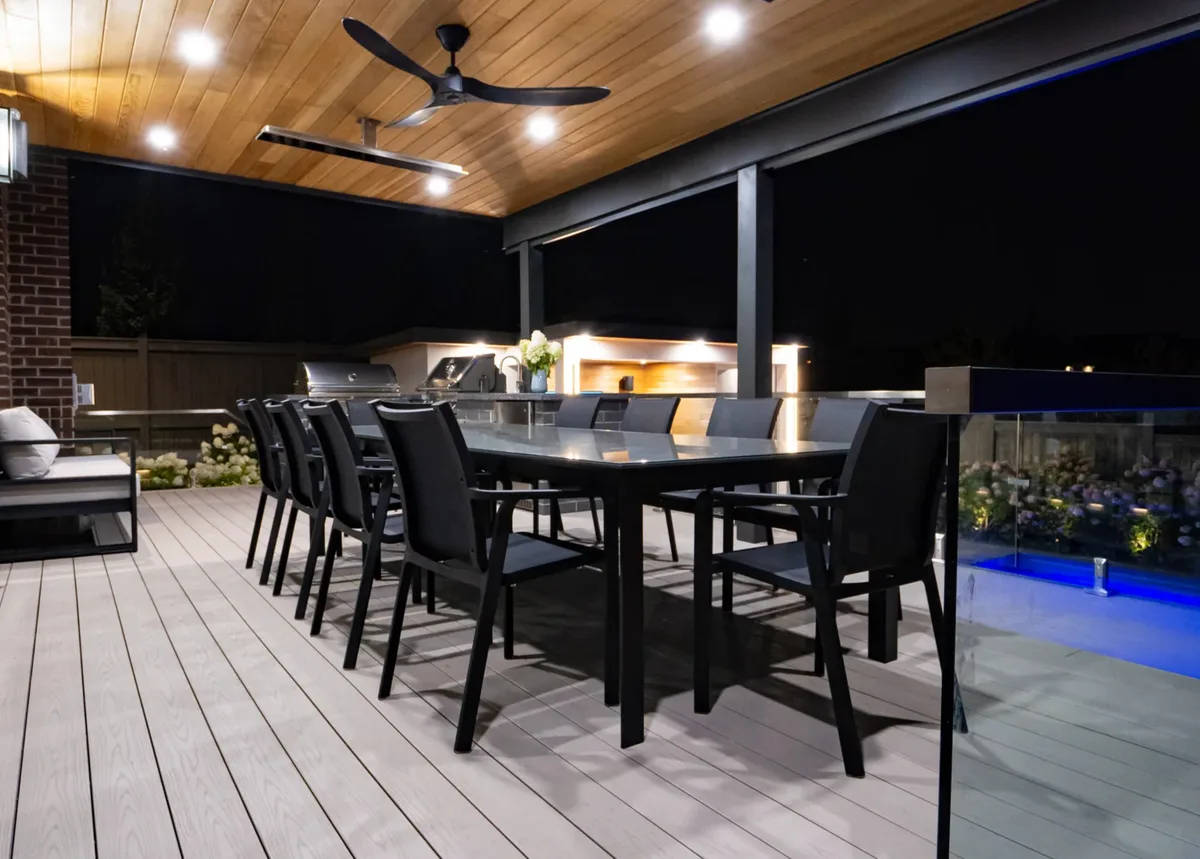
Which Material Fits Which Backyard
The right material depends on how the deck will be used, where it sits on the property, and what matters most to the owner.
| Backyard Type | Best Fit | Why |
|---|---|---|
| Standard raised family deck | Composite | Good value and lower typical movement |
| Pool or spa deck with frequent splash | PVC | High moisture and stain resistance |
| Tight picture frames and diagonal patterns | Composite | Easier to detail for thermal movement |
| Low-clearance sleeper deck | PVC or specialty composite | Moisture and airflow risk dominate |
| Budget-sensitive upgrade from wood | Composite | Lowest entry among low-maintenance options |
| Luxury entertaining deck with upgraded railings | Depends on exposure | Detailing matters more than category |
| Homeowner wants the least routine upkeep | PVC | Clear case for low-maintenance wet zones |
For projects where the deck is part of a larger outdoor environment, the material decision should be made alongside the full project plan:
- Layout and traffic flow between zones
- Drainage coordination with adjacent features
- Lighting placement for safety and evening use
- A deck that connects to a Pool Installation, Outdoor Kitchens, or Pergolas has different structural and detailing requirements than a standalone platform
- Adjacent surfaces like Interlocking, Natural Stone, or Fire Features need coordinated grading, drainage, and transition detailing
How a Deck Fits Into a Complete Outdoor Environment
Precision Landscaping plans Deck Installation alongside the surrounding Landscape Design. A coordinated approach includes:
- Mapping traffic flow between the house, the deck, and features like pools, dining areas, and garden zones before framing starts
- Lighting integrated into the deck and railing system to extend usable hours and add safety
- Hardscaping at grade level to create transitions between the deck surface and pool patios, walkways, and planting beds
- Selecting the deck material inside a complete design brief that coordinates structure, finish, and surrounding landscape
Frequently Asked Questions About Decking Costs in Ontario
These are the most common questions homeowners ask when comparing PVC and composite decking in Ontario.
-
Yes. Both materials are designed to handle freeze-thaw cycling, snow loads, and seasonal temperature swings when installed according to manufacturer specifications. The critical factor is the quality of the framing, gapping, fastening, and drainage underneath the boards.
-
Both materials retain heat in direct sun, and darker colours will feel noticeably warmer underfoot during summers. Lighter colour selections and shaded areas reduce surface temperature. This is an important consideration for pool decks and south-facing installations.
-
Ice melt recommendations vary by manufacturer and product line. Some allow calcium chloride only. Others allow rock salt with prompt rinsing. Sand is generally not recommended because it can scratch the surface. Check the specific product's care guide before applying any ice melt product.
-
PVC typically costs more than composite upfront but offers stronger moisture resistance, lower maintenance, and longer warranty coverage in premium lines. It is most worth the extra cost for pool decks, spa-adjacent areas, and homeowners who want the absolute lowest routine upkeep. For family decks without heavy moisture exposure, composite often provides better overall value.
-
Most municipalities require a building permit for attached decks. Permit requirements typically include footing depth, framing details, guard height, and setback documentation. Low detached platforms may qualify for simplified paths, but requirements vary by municipality. In Toronto, the online permit system handles most residential deck applications.
-
Resurfacing is often viable if the existing framing is structurally sound, properly spaced, and in good condition. Not all existing frames are compatible with all composite or PVC products. Joist spacing, ventilation, and load requirements may differ from the original wood deck specification. A site inspection is necessary before committing to a resurfacing approach.
-
Both composite and PVC decks are viewed favourably by Ontario buyers because they signal low maintenance and modern construction. The resale impact depends more on the overall quality of the deck, including railings, lighting, integration with the landscape, and condition at the time of sale, than on whether the boards are PVC or composite.
Build the Right Deck for Your Outdoor Environment
The right deck is not just the right board. It is the right structure underneath it. Precision Landscaping designs and builds Deck Installation projects as part of fully integrated outdoor environments, coordinating material selection, substructure, and surrounding Landscape Design into one project. Contact Precision Landscaping for a design consultation.